

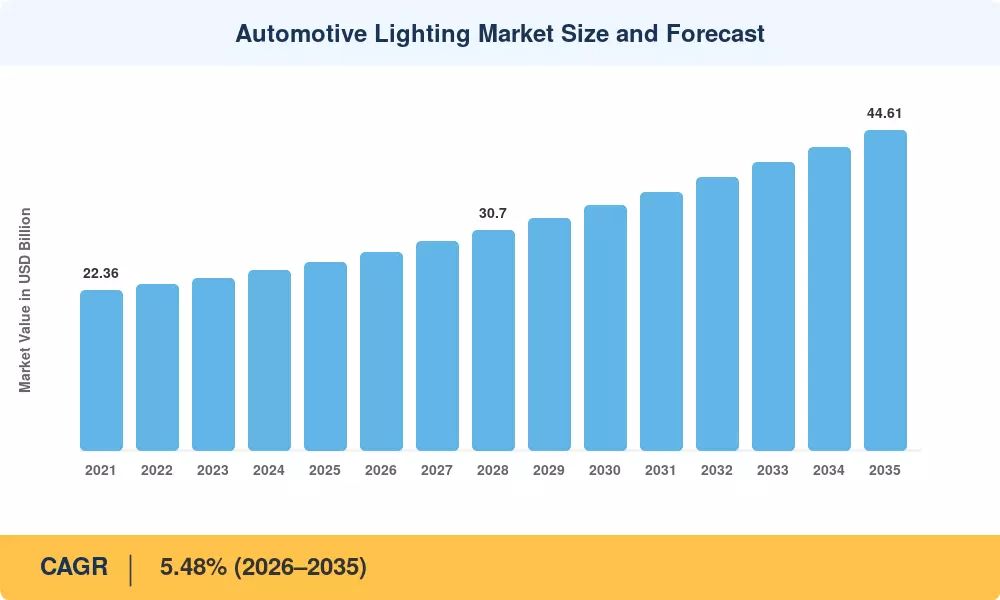
Automotive Lighting Market to Reach USD 44.61 Billion by 2035, Growing at 5.48% CAGR
Automotive Lighting Market
OEM installations accounted for roughly 81.0% of revenues in the Automotive Lighting Market in 2025, given that most lighting systems are factory-fitted.
NEW YORK, NY, UNITED STATES, September 1, 2026 /EINPresswire.com/ -- According to Market Research Future, the Automotive Lighting Market is projected to grow from USD 27.59 Billion in 2026 to USD 44.61 Billion by 2035, registering a CAGR of 5.48% during the 2026–2035 period, driven by Integration of smart lighting systems enhances safety and efficiency. This steady growth reflects the ongoing evolution of vehicle lighting from a basic safety component to an intelligent, software-driven system that enhances driver visibility, vehicle aesthetics, and communication with other road users. The Automotive LED Lighting Market continues to advance as LED technology gains further penetration across all vehicle segments, while the Automotive Adaptive Lighting Market is emerging as a key growth vector as automakers integrate matrix LED and pixel lighting systems that dynamically adjust beam patterns to traffic conditions.Market Overview
Automotive lighting encompasses a comprehensive range of exterior and interior illumination systems including headlamps, tail-lights, fog lamps, and ambient lighting that serve both functional and aesthetic purposes in modern vehicles. The market is witnessing a fundamental transformation as traditional halogen and xenon systems are rapidly replaced by LED, OLED, and laser technologies that offer superior energy efficiency, design flexibility, and advanced functionality. The Automotive LED Lighting Market is at the forefront of this transition, with LED technology now dominating new vehicle production across passenger and commercial segments. The Automotive Adaptive Lighting Market represents the next frontier, with matrix LED and pixel lighting systems enabling dynamic beam patterns that improve visibility while reducing glare.
The key growth drivers propelling this market expansion include the increasing adoption of LED and adaptive lighting technologies, which offer superior energy efficiency and dynamic functionality. Strict government regulations regarding road safety and vehicle lighting standards are driving automakers to adopt advanced lighting systems, with the implementation of stricter safety norms further spurring market growth. Growing consumer demand for vehicle aesthetics and personalization is fueling the adoption of premium lighting options, including signature daytime running lights and dynamic turn signals. The rapid expansion of electric vehicle production is creating additional demand for energy-efficient lighting solutions that maximize range.
Technological developments are reshaping the automotive lighting landscape at an accelerating pace. The integration of smart lighting systems with Advanced Driver Assistance Systems has transformed lighting into an outward-facing sensor network, with Bosch pairing its Gen3 multi-purpose camera with headlamps on heavy trucks to reduce nighttime crash rates. Matrix LED and microLED technologies are enabling pixel-level light control, allowing headlamps to project symbols onto the road surface for improved driver communication. OLED and laser technologies are emerging for premium applications, offering unprecedented design freedom and lighting performance.
Market Segmentation
The automotive lighting market is segmented based on vehicle type, application, technology, and sales channel to provide comprehensive insights into the industry landscape.
By Vehicle Type: The market is categorized into Passenger Cars, Light Commercial Vehicles, Two-Wheelers, and Heavy Commercial Vehicles. Passenger cars dominate the market, accounting for a significant majority of demand due to high vehicle production volumes and consumer preference for premium lighting features. The integration of interior and exterior lighting systems in passenger vehicles, including advanced headlamps, rear lighting, and ambient illumination, continues to drive segment growth. Medium and heavy commercial vehicles are expected to post strong growth, driven by regulations pairing adaptive beams with collision-mitigation braking on long-haul trucks.
By Application: The market covers Exterior lighting including headlamps, tail-lights, fog lamps, and other exterior lighting, as well as Interior lighting including ambient and footwell lighting and roof and dome lighting. Exterior systems hold a commanding market share, with headlamps representing the largest application segment due to their critical safety function and ongoing technological advancement. Interior adaptive lighting is rising rapidly, particularly as electric and autonomous vehicles use color and intensity shifts to substitute for engine sound as feedback to occupants.
By Technology: The market is segmented into LED, Halogen, Xenon/HID, OLED, and Laser technologies. LED holds the largest market share, driven by widespread adoption in rear lighting due to power efficiency and rapid cost reduction. LED technology is now standard across most vehicle segments, with LED headlamps achieving more than 50% penetration of the global market. OLED and laser technologies are gaining traction in premium segments, offering enhanced design flexibility and superior performance. Halogen remains present in entry-level vehicles and emerging markets due to lower cost, while Xenon/HID continues to decline as LED becomes more affordable.
By Sales Channel: The market is divided into OEM and Aftermarket channels. OEM represents the largest channel, with vehicle manufacturers accounting for the majority of lighting system purchases as they integrate advanced lighting technologies during vehicle production. The growing emphasis on distinctive lighting design has strengthened OEM purchasing power, as automakers drive lighting trends through signature LED daytime running lights and dynamic turn signals. The aftermarket provides replacement and upgrade opportunities, though dealership retrofits for adaptive systems remain limited due to warranty considerations.
By Region: The market analysis covers North America, Europe, South America, Asia Pacific, and the Middle East and Africa.
🛒 You can buy this market report at:
https://www.marketresearchfuture.com/checkout?currency=one_user-USD&report_id=1819
Regional Analysis
Asia Pacific emerges as the dominant and fastest-growing regional market, capturing approximately 45% of the automotive lighting market revenue. The region's dominance is anchored by extensive automotive production capacity across China, Japan, India, and South Korea, which together account for a substantial share of global vehicle output. China, as the world's largest vehicle manufacturer and EV producer, drives significant demand for advanced lighting technologies, with domestic automakers adopting adaptive lighting as a status symbol in electric models. India is emerging as a key growth market, driven by increasing vehicle production, rapid urbanization, and rising disposable incomes of the growing middle-class population. Japanese suppliers including Koito Manufacturing and Stanley Electric are expanding factories across ASEAN and Latin America to support global vehicle platforms.
Europe maintains a significant market position, supported by strict safety regulations, strong demand for premium vehicles, and advanced technological innovation. Germany leads the region, with German premium OEMs continuing to trickle down high-resolution lighting systems into more affordable models, forcing volume brands to adopt similar technology or risk market share erosion. The European market benefits from ECE R123 regulations that set a high bar for glare-free performance, nudging new platforms toward matrix LED or laser lighting. Production costs are being squeezed as suppliers shift assembly to lower-cost Eastern European facilities while maintaining proximity to EU plants. The region's leadership in adaptive lighting technology is reinforced by the presence of key suppliers including HELLA, Valeo, and ZKW Group.
North America represents a mature and strategically important market, with the U.S. market finally unlocking pent-up demand following NHTSA approval of adaptive beam technology. The region is growing at a measured pace as automakers migrate toward single global lamp architectures that can be recalibrated in software, limiting tooling changes across regions. Suppliers are localizing micro-LED production in Mexico to capitalize on USMCA rules-of-origin credits while reducing shipping lead times. The market benefits from substantial investments in electric vehicle production and charging infrastructure, creating opportunities for energy-efficient lighting solutions.
South America and the Middle East and Africa represent developing markets with growing potential. In South America, revenue growth is supported by SUV-heavy lineups where buyers accept feature premiums. The Middle East and Africa benefit from economic diversification and smart city development initiatives in countries like the UAE and Saudi Arabia, though the lack of stringent lighting regulations still limits full matrix lighting rollouts. The Indian automotive lighting market is projected to witness significant growth, driven by government safety regulations supporting the adoption of modern lighting technologies.
Competitive Landscape and Key Players
The automotive lighting market is highly competitive, featuring a mix of established global suppliers, specialized technology providers, and regional manufacturers. The competitive landscape is characterized by technological innovation, strategic partnerships, and vertical integration across the lighting value chain.
Key players operating in this market include Koito Manufacturing Co., Ltd., Stanley Electric Co., Ltd., Valeo SA, HELLA GmbH & Co. KGaA (Forvia), Marelli Holdings Co., Ltd., ZKW Group GmbH, SL Corporation, OSRAM GmbH, Lumileds Holding BV, Varroc Group, and Magna International Inc.. Japanese manufacturers Koito and Stanley maintain strong positions in the global market, supported by deep relationships with major automakers and continuous investment in LED and adaptive lighting technologies. European suppliers HELLA and Valeo lead in adaptive lighting and system integration, while ZKW Group, a member of South Korea's LG Group since 2018, specializes in premium digital lighting solutions. Asian suppliers including SL Corporation and Varroc Group are expanding their global presence through strategic partnerships and technology development.
Strategic developments are reshaping the competitive landscape. Manufacturers are investing heavily in microLED and pixel lighting technology that enables digital light processing for road projection and communication functions. Partnerships between lighting suppliers and semiconductor companies are accelerating the development of intelligent lighting systems that integrate with ADAS and autonomous driving platforms. Suppliers are also localizing production to meet regional content requirements and reduce tariff exposure, with component suppliers moving manufacturing to Mexico, Eastern Europe, and Southeast Asia. The competitive environment is intensifying as automakers increasingly view lighting as a differentiator and consolidate lighting development into single global architectures.
Innovation and technology initiatives are accelerating across the industry. Companies are developing modular lighting platforms that support software-defined features, allowing over-the-air updates and subscription-based lighting upgrades. The integration of ADAS sensors with lighting systems is enabling new safety features, such as active hazard highlighting and vulnerable road user illumination. Interior lighting is evolving toward cabin-centric systems that integrate with voice assistants and biometric sensors to create personalized lighting scenes based on driver mood or route conditions. Sustainability initiatives, including energy-efficient designs and reduced material usage, are becoming increasingly important as automakers pursue carbon neutrality goals.
Latest Industry News and Developments
Recent industry developments highlight the dynamic nature of the automotive lighting market. In July 2023, Marelli, together with ams OSRAM, launched a groundbreaking innovation in automotive front lighting, introducing the h-Digi microLED module, which is now in series production. This digital lighting solution enables fully adaptive, dynamic headlight operation and image projection while being affordable for a wider range of vehicles. In July 2025, Italy's Consip launched a €650 million tender for 600 electric buses, with advanced lighting systems included among the technical specifications, demonstrating the growing demand for energy-efficient lighting in electric commercial vehicles. In February 2026, the Federal Highway Administration underscored its commitment to digitizing freight corridors by adding roadside units along a major U.S. interstate, highlighting the intersection of vehicle lighting and connected infrastructure.
Market Challenges and Opportunities
The automotive lighting market faces several key challenges that could impact growth trajectories. Adaptive headlamps still cost 2-4 times as much as fixed LEDs, limiting uptake in cost-sensitive markets. Thermal management in high-lumen LED and laser units presents ongoing technical challenges, requiring advanced cooling solutions. Dealership retrofits for adaptive systems are scarce due to warranty and complexity concerns, limiting aftermarket revenue potential. Intense competition in the automotive lighting LED market is compressing profit margins for suppliers, with market value projected to decline due to pricing pressure.
Emerging opportunities are abundant in the evolving automotive landscape. The transition to electric vehicles is accelerating demand for energy-efficient lighting solutions that maximize range. The integration of smart lighting with ADAS and autonomous driving systems is creating new value propositions through camera-based lighting control and road projection features. Software-defined lighting platforms enable subscription-based features and over-the-air upgrades, creating recurring revenue streams. The expansion of vehicle personalization and the growing demand for distinctive vehicle styling continue to drive adoption of premium lighting options, including full-width light bars, intelligent ambient lighting, and ground projection features.
To explore more market insights, visit us at:
https://www.marketresearchfuture.com/reports/automotive-lighting-market-1819
Final Market Summary
The automotive lighting market is positioned for steady growth, driven by technological advancement, safety regulations, and the accelerating transition to electric and autonomous vehicles. The market's trajectory from USD 27.59 Billion in 2026 to USD 44.61 Billion by 2035 reflects the ongoing evolution of vehicle lighting from basic illumination to intelligent, software-driven systems that enhance safety, efficiency, and vehicle design.
The long-term industry potential remains bright, with advancements in LED technology, microLED arrays, and intelligent lighting systems continuing to expand the addressable market. The convergence of automotive lighting with broader vehicle electronics, including ADAS, autonomous driving platforms, and connected vehicle systems, is creating comprehensive solutions that serve diverse vehicle needs across passenger and commercial segments.
Key factors expected to influence future development include the pace of electric vehicle adoption, the evolution of regulatory frameworks for adaptive lighting, and the advancement of software-defined vehicle architectures. The development of affordable adaptive lighting solutions and the expansion of tiered feature packages will accelerate adoption across price segments. As vehicles become increasingly connected, electric, and autonomous, the role of advanced lighting systems will continue to expand, ensuring sustained innovation and growth throughout the forecast period and beyond.
More Related Reports from MRFR Library:
India Heavy Duty Trucks Market : https://www.marketresearchfuture.com/reports/india-heavy-duty-trucks-market-56731
Aircraft Engine Maintenance and Overhaul Market : https://www.marketresearchfuture.com/reports/aircraft-engine-maintenance-and-overhaul-market-65873
Food Packaging Equipment MRO Services Market : https://www.marketresearchfuture.com/reports/food-packaging-equipment-mro-services-market-66794
Food Processing Equipment Maintenance Services Market : https://www.marketresearchfuture.com/reports/food-processing-equipment-maintenance-services-market-66796
Automotive Sensor Market : https://www.marketresearchfuture.com/reports/automotive-sensor-market-789
Powersports Market : https://www.marketresearchfuture.com/reports/powersports-market-877
Microcontroller Embedded Systems Market : https://www.marketresearchfuture.com/reports/microcontroller-embedded-systems-market-911
In Car infotainment Market : https://www.marketresearchfuture.com/reports/in-car-infotainment-market-1153
Automotive Coil Spring Market : https://www.marketresearchfuture.com/reports/automotive-coil-spring-market-1157
Bluetooth in Automotive Market : https://www.marketresearchfuture.com/reports/bluetooth-in-automotive-market-1262
Market Research Future
Market Research Future
+1 855-661-4441
email us here
Legal Disclaimer:
EIN Presswire provides this news content "as is" without warranty of any kind. We do not accept any responsibility or liability for the accuracy, content, images, videos, licenses, completeness, legality, or reliability of the information contained in this article. If you have any complaints or copyright issues related to this article, kindly contact the author above.
