

Electricity Retailing Market Establish a Massive Growth of USD 5.41 Trillion, Projecting a CAGR of 5.22% Till 2035
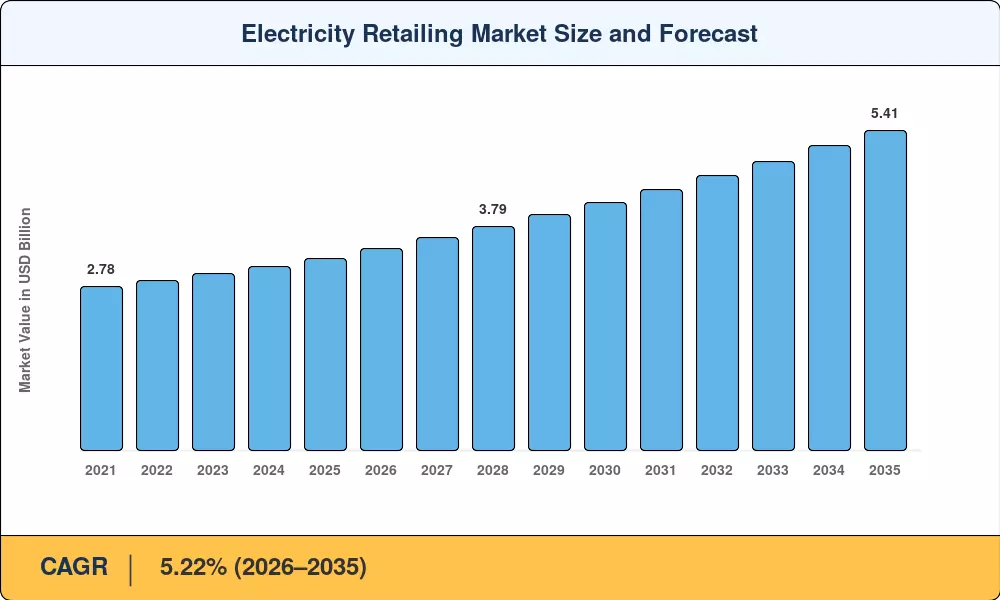
Electricity Retailing Market Summary
Asia-Pacific led the market with a 49% revenue share in 2025, underpinned by China's provincial retail-pilot expansion and India's open-access reforms.
Fixed/flat-rate tariffs accounted for 47.5% of electricity retailing market revenue in 2025, reflecting consumer preference for bill predictability amid wholesale-price volatility.”
NY, CA, UNITED STATES, July 15, 2026 /EINPresswire.com/ -- Electricity retailing encompasses the final stage of the electricity supply chain, involving the sale and delivery of electric power from wholesale markets or generators to end-use consumers including residential, commercial, and industrial customers. Retailers purchase electricity from wholesale markets, manage pricing structures, handle billing and customer service, and increasingly provide value-added services like energy management, demand response, and renewable energy certification. The market operates under diverse regulatory frameworks ranging from fully competitive retail structures to regulated monopoly utilities, with many regions undergoing progressive liberalization.— Arti Dhapte
Electricity Retailing Market Overview
The global electricity retailing market share was valued at USD 3.25 trillion in 2025 and is projected to grow from USD 3.42 trillion in 2026 to USD 5.41 trillion by 2035, registering a CAGR of 5.22% during the forecast period (2026–2035). Two structural forces are reshaping revenue trajectories for power retailers: government-mandated decarbonization timelines — the EU's Fit for 55 package alone mobilizes over EUR 300 billion in clean-energy investment through 2030 — and the rapid electrification of transportation, which the IEA projects will add roughly 1,500 TWh of incremental global demand by 2030.
The market is experiencing robust growth driven by several key factors. Transport electrification and EV-charging load represent the most significant demand driver, with global EV sales surpassing 17 million units in 2024 and the IEA projecting a fleet exceeding 250 million vehicles by 2030. Each battery-electric vehicle adds an estimated 3,000–4,000 kWh of annual consumption, creating a structural uplift for retailers that secure charging-point supply contracts. Public fast-charging networks in the U.S. alone received USD 7.5 billion under the NEVI program, channeling new demand to retail suppliers capable of offering time-of-use or dynamic pricing at the plug.
Industry trends indicate a decisive transformation in tariff structures from legacy fixed-rate plans to dynamic, digitally enabled offerings. Retailers that have engaged in smart meter rollouts and cloud-based billing platforms now control more than 400 million advanced metering endpoints worldwide, providing real-time pricing and demand-side flexibility services. Over 1.4 billion smart meters have been installed globally, enabling granular 15-minute interval data that allows retailers to design personalized tariffs and demand-response incentives, improving customer retention rates by an estimated 12–18% compared with flat-rate alternatives.
Technological developments are reshaping the market landscape. AI-driven customer analytics and dynamic pricing using machine-learning models trained on interval meter data can forecast individual household demand with 92–95% accuracy, enabling real-time tariff personalization. Retailers deploying such platforms report churn reductions of 15% and gross-margin improvements of 50–80 basis points per customer. Bundled Energy-as-a-Service models combining electricity supply with EV-charging subscriptions, home-battery leasing, and smart-thermostat management can lift customer lifetime value by 25–40%.
Policy and regulatory influence continues to shape market dynamics. The EU's revised Renewable Energy Directive targets a 42.5% renewables share by 2030, shifting the tariff mix toward green-backed products and creating margin opportunities for retailers who can certify supply-chain provenance. Regulatory agencies in OECD countries are tightening consumer-protection responsibilities, requiring retailers to balance tariff innovation with affordability obligations. Mandatory climate-disclosure regimes including the EU's CSRD and SEC's climate-risk rules compel corporate buyers to demonstrate verifiable Scope 2 emission reductions.
The Asia-Pacific region has the highest share of the electricity retailing industry, with a share of around 49% of worldwide income, owing to continuing power-sector reform in China and distribution revamp under UDAY in India. The region is also leading the rise at a predicted CAGR of 6.14%. Europe, contributing about 24% of worldwide sales and benefiting from aggressive renewable-integration targets, is next. North America, where data-center load and EV-charging infrastructure build-outs are reshaping peak-demand patterns, rounds out the top three.
Get Free Sample Report for Detailed Market Insights:
https://www.marketresearchfuture.com/sample_request/35068
Electricity Retailing Market Segmentation
By Tariff Type
Fixed/Flat-Rate: Accounted for 47.5% of market revenue in 2025, reflecting consumer preference for bill predictability amid wholesale-price volatility
Time-of-Use: Valued at USD 0.52 trillion, driven by smart-meter rollouts enabling peak/off-peak splits
Dynamic/Real-Time: Growing at 6.85% CAGR, driven by data-center and industrial demand flexibility
Green/Renewable-Backed: Fastest-growing at 7.92% CAGR, fueled by corporate ESG commitments and prosumer growth
Subscription-Based: Valued at USD 0.10 trillion, featuring fintech-style flat-fee energy plans
By End-User
Industrial: Represented the largest share, driven by energy-intensive manufacturing clusters in Asia and Europe
Commercial: Projected to record a 6.35% CAGR as office electrification, on-site EV charging, and smart-building retrofits accelerate demand
Residential: Valued at USD 0.88 trillion, supported by population growth and appliance electrification
Competitive Landscape / Key Players
The power retailing market is globally not very concentrated – the Herfindahl-Hirschman Index is below 800 globally – but it can be highly concentrated on a national basis. The top five global retailers account for an estimated 18-24% of overall market revenue.
EDF Group (~4-6% revenue share): Offers regulated and competitive supply, nuclear-backed green tariffs, vertically integrated, dominant in France and the UK.
E.ON SE (~3-5%): Provides residential/commercial supply, smart-home energy services as a pan-European customer platform post-Innogy integration.
Enel SpA (~3-5%): Operates global retail operations, green-power plans, e-mobility with multi-continental reach across Europe and Latin America.
Engie SA (~2-4%): Focuses on B2B energy management, decentralized energy solutions with commercial and industrial focus, energy-as-a-service.
Iberdrola SA (~2-4%): Delivers renewable-backed retail supply, EV infrastructure with green-generation vertical integration and UK/US presence.
Other notable players include NextEra Energy, Tokyo Electric Power (TEPCO), Duke Energy, Origin Energy, and AGL Energy. Recent developments include Microsoft and Brookfield finalizing a 10.5 GW global renewable PPA establishing a benchmark for 24/7 clean-energy procurement, and Ofgem transitioning the UK energy price cap to quarterly recalibration.
Latest Industry News & Developments
Microsoft & Brookfield (September 2024): Finalized a 10.5 GW global renewable PPA — the largest single-buyer contract to date — establishing a benchmark for 24/7 clean-energy procurement in the electricity retailing market.
Ofgem (July 2024): Transitioned the UK energy price cap to quarterly recalibration, tightening wholesale-price pass-through windows for British retail suppliers.
India Ministry of Power (April 2024): Issued draft Electricity (Promoting Renewable Energy Through Green Energy Open Access) Rules, lowering open-access thresholds and expanding competitive supply eligibility.
You can buy this market report at:
https://www.marketresearchfuture.com/checkout?currency=one_user-USD&report_id=35068
Electricity Retailing Market Regional Analysis
Asia-Pacific
Asia-Pacific led the electricity retailing market with a 49% revenue share in 2025, underpinned by China's provincial retail-pilot expansion and India's open-access reforms. China accounts for 52% of regional revenue, with ongoing electricity-market reform piloting spot trading in Guangdong, Zhejiang, and Shandong, progressively exposing industrial and commercial load to competitive retail pricing. India's state-level open-access reforms are expanding competitive supply options for industrial consumers, with a 6.50% CAGR as states lower contract-demand floors to open millions of commercial connections to third-party supply. Japan's full liberalization since 2016 and South Korea's KEPCO unbundling discussions further contribute to regional growth.
Europe
Europe contributes about 24% of global sales, benefiting from aggressive renewable-integration targets. Germany accounts for 28% of regional revenue, driven by Energiewende and prosumer density. The UK's Ofgem cap reform and green-tariff proliferation support a 5.10% CAGR. France's TRV phase-down for commercial users and Spain's renewable-auction contracts and self-consumption law contribute to regional growth. The EU's Clean Energy Package requires member states to ensure every consumer can freely choose and switch supplier without penalty.
North America
North America is poised for robust expansion as hyperscale data centers and public-charging networks drive unprecedented load growth. The United States accounts for 78% of regional revenue, spanning fully deregulated states where dozens of competitive suppliers operate alongside regulated vertically integrated utilities. Texas' ERCOT zone alone processed over 25 million customer switches cumulatively by 2024, making it one of the world's most liquid retail power markets. Canada's competitive provinces pursue parallel liberalization agendas, while Mexico's industrial consumers increasingly access private-generator supply under bilateral contracts.
Rest of the World
South America, led by Brazil with 72% of regional revenue, is progressively reducing the free-consumer eligibility threshold with full residential opening expected by 2028. The Middle East & Africa remains largely utility-dominated, though structural reform is accelerating with Saudi Arabia's Vision 2030 IPP procurement and South Africa's Eskom unbundling creating future pathways for competitive supply.
Electricity Retailing Market Challenges & Opportunities
Key Restraints
Regulated default-tariff caps such as Ofgem's Energy Price Cap in the UK and France's Tarif Réglementé compress retailer gross margins to as low as 1.5-2.0% in capped segments. Wholesale-price volatility from the 2022-2023 European energy crisis demonstrated how spot-price swings exceeding 300% can bankrupt under-hedged retailers within months. Prosumer self-consumption erosion, with rooftop solar installations crossing 300 GW globally by 2024 and battery-storage attach rates above 30% in markets like Australia and Germany, amplifies grid-defection risk. Customer-switching inertia in monopoly regions and cybersecurity and data-privacy compliance costs further constrain growth.
Emerging Opportunities
Bundled Energy-as-a-Service models combining electricity supply with EV-charging subscriptions, home-battery leasing, and smart-thermostat management can lift customer lifetime value by 25-40%. Emerging-market deregulation in India, Brazil, and other nations is creating new competitive entry points as regulatory frameworks modernize. Grid-edge flexibility monetization through Virtual Power Plants aggregating distributed batteries, heat pumps, and smart loads enables capacity and balancing-market revenues. AI-driven customer analytics and dynamic pricing reduce churn and improve gross margins. Cross-border renewable certificate trading using distributed ledger technology reduces administrative friction and transaction costs.
Future Potential
AI-optimized retail operations will significantly increase automation of routine customer interactions, lowering cost-to-serve by an estimated USD 3-5 per customer annually. Platform economics and energy aggregation models are evolving supply businesses into two-sided marketplaces, dramatically lowering customer-acquisition costs. The electrification supercycle, with the IEA forecasting global electricity demand to rise 75% by 2050, guarantees volume growth while shifting competitive advantage toward flexible sourcing portfolios. ESG reporting and Scope 2 compliance will capture premium pricing for retailers offering hourly-matched green supply backed by independently audited certificate chains.
To explore more market insights, visit us at:
https://www.marketresearchfuture.com/reports/electricity-retailing-market-35068
The global Electricity Retailing Market is positioned for sustained growth, with projections indicating expansion from USD 3.42 trillion in 2026 to USD 5.41 trillion by 2035, registering a 5.22% CAGR. Market dynamics are driven by the convergence of transport electrification, renewable-energy integration mandates, and smart-metering digital platforms. The shift from legacy fixed-rate tariffs to dynamic, green-backed, and subscription-based offerings is transforming the retail landscape.
Asia-Pacific leads the market with 49% revenue share and the fastest regional growth at 6.14% CAGR, driven by power-sector reform in China and industrial open-access in India. Europe follows with 24% share supported by aggressive renewable targets and the EU Clean Energy Package. North America contributes significant growth with data-center load and EV infrastructure reshaping demand patterns. While challenges including regulated tariff caps and wholesale-price volatility persist, the long-term industry outlook remains robust, supported by the essential role of electricity retailers in enabling decarbonization, managing demand flexibility, and serving as the interface between wholesale power markets and end-use consumers. The decade ahead will reward retailers who leverage AI analytics, platform-based aggregation, and bundled services to capture value in a rapidly electrifying economy.
More Related Reports from MRFR Library:
Commercial Aircraft Aviation Fuel Market https://www.marketresearchfuture.com/reports/commercial-aircraft-aviation-fuel-market-35227
Completion Equipment and Service Market https://www.marketresearchfuture.com/reports/completion-equipment-and-service-market-35257
Industrial Demand Response Management System Market https://www.marketresearchfuture.com/reports/industrial-demand-response-management-system-market-35258
Construction Portable Generator Market https://www.marketresearchfuture.com/reports/construction-portable-generator-market-35263
DC Distribution Network Market https://www.marketresearchfuture.com/reports/dc-distribution-network-market-35267
Deep Water and Ultra Deep Water Exploration Production Market https://www.marketresearchfuture.com/reports/deep-water-ultra-deep-water-exploration-production-market-35271
Digital Instrument Transformer Market https://www.marketresearchfuture.com/reports/digital-instrument-transformer-market-35310
High Voltage Measuring Equipment Market https://www.marketresearchfuture.com/reports/high-voltage-measuring-equipment-market-35346
Horizontal Directional Drilling Equipment Market https://www.marketresearchfuture.com/reports/horizontal-directional-drilling-equipment-market-35448
Transformer Tap Changers and Voltage Control Relay Market https://www.marketresearchfuture.com/reports/transformer-tap-changers-voltage-control-relay-market-35789
Larry Wilson
WantStats Research And Media Pvt. Ltd.
+1 855-661-4441
email us here
Visit us on social media:
LinkedIn
Facebook
YouTube
X
Legal Disclaimer:
EIN Presswire provides this news content "as is" without warranty of any kind. We do not accept any responsibility or liability for the accuracy, content, images, videos, licenses, completeness, legality, or reliability of the information contained in this article. If you have any complaints or copyright issues related to this article, kindly contact the author above.
