

Sterilization Equipment Market to reach USD 17.41 Billion by 2035 at 6.8% CAGR
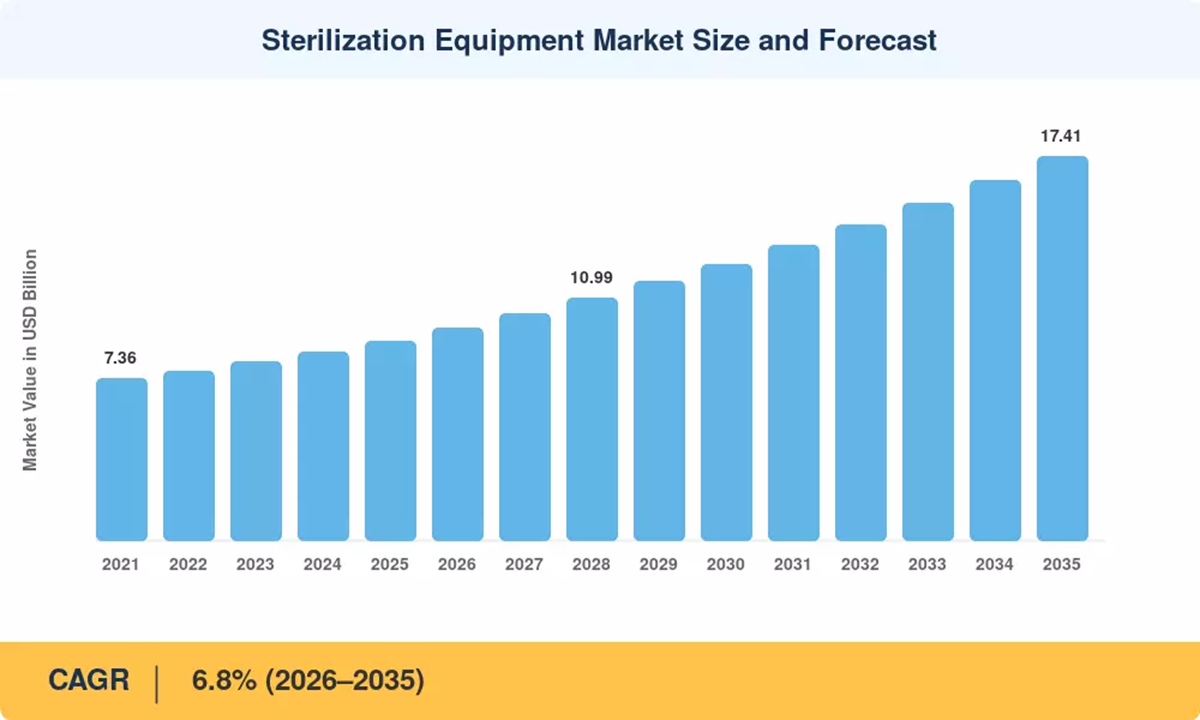
Sterilization Equipment Market Size
Sterilization Equipment Market to Surge from $9.63B in 2026 to $17.41B by 2035-By Rising Global Surgical Procedure Volumes, Infection-Prevention Regulatory
NY, CA, UNITED STATES, July 14, 2026 /EINPresswire.com/ -- As per Market Research Future, the global Sterilization Equipment Market size to reach USD 17.41 Billion by 2035 from USD 9.63 Billion in 2026, at a CAGR of 6.8% during the forecast period 2026--2035. The market base was estimated at USD 9.02 Billion in 2025.The 6.8% CAGR---anchored by structural infection prevention demand rather than discretionary healthcare spending---is driven by three converging forces: the WHO's updated decontamination protocols for surgical instruments across 194 member states, a post-pandemic wave of central sterile services department (CSSD) capital upgrades worth an estimated USD 4.3 billion across OECD hospital systems between 2023 and 2026, and the proliferation of robotic-assisted surgical platforms---with deployed systems surpassing 9,500 globally by the end of 2024---that require heat-sensitive low-temperature sterilization cycles incompatible with legacy steam autoclaves. The Sterilization Equipment Market is no longer a back-of-house cost center---it sits at the intersection of patient safety, regulatory compliance, and surgical technology evolution.
National governments and multilateral health organizations are amplifying this momentum. The U.S. FDA's 2024 update to its Reprocessing Medical Devices guidance tightened biological-indicator pass rates for Class II device reprocessing, effectively requiring hospitals to replace sterilizers older than 15 years or retrofit them with enhanced monitoring.
The European Union's revised Medical Device Regulation (EU MDR 2017/745), fully enforced since 2024, has mandated traceability from decontamination through to the point of use, driving software-enabled sterilizer demand across the continent. India's Ayushman Bharat hospital-expansion program and China's county-hospital upgrade initiative are creating first-time equipment demand in Tier-2 and Tier-3 cities. Together, these initiatives are creating the procurement infrastructure and quality assurance frameworks on which the Sterilization Equipment Market depends.
Request A Free Sample: https://www.marketresearchfuture.com/sample_request/6397
Key Market Trends & Growth Drivers
Rising Global Surgical Procedure Volumes
The number of inpatient surgical procedures worldwide exceeded 340 million in 2024, up from an estimated 313 million in 2019, according to Lancet Commission data extrapolated through national health-system reporting. Each procedure generates an average of 12--18 reprocessed instrument sets, directly translating into sterilizer throughput requirements.
Regions with aging populations---Japan, Germany, Italy---face compounding demand as joint-replacement and cataract-surgery rates climb 4--6% annually, tightening CSSD cycle times and driving capacity-expansion purchases across the Sterilization Equipment Market. Each percentage point of surgical volume growth translates into measurable procurement volume, and the multi-procedure paradigm embedded in hospital operations makes this driver structurally durable through 2035.
Infection-Prevention Regulatory Mandates
The FDA's 2024 update to its Reprocessing Medical Devices guidance (FDA-2023-D-4512) tightened biological-indicator pass rates for Class II device reprocessing, effectively requiring hospitals to replace sterilizers older than 15 years or retrofit them with enhanced monitoring. Across the Atlantic, EU MDR Annex I safety requirements now mandate unique device identification (UDI) integration into sterilization records, adding a software-driven upgrade cycle to the hardware replacement wave.
These dual mandates create a compliance-driven floor under demand that persists regardless of hospital budget cycles. The 2024 enforcement of EU MDR traceability requirements in major markets created a structural digital-sterilizer tail, supporting premium-priced software-enabled platform demand that legacy regions cannot match.
Ambulatory Surgery Center Expansion
The U.S. alone added approximately 420 new ambulatory surgery centers (ASCs) between 2022 and 2024, each requiring dedicated sterilization capacity. ASCs typically install tabletop steam sterilizers and compact low-temperature units with rapid turnaround cycles, a configuration that commands USD 120,000--250,000 per site.
Growth in Asia-Pacific mirrors this trend---India's National Health Authority approved 1,200+ day-surgery facilities under Ayushman Bharat between 2023 and 2025, generating first-time equipment demand in Tier-2 and Tier-3 cities. In areas where outpatient procedure migration and cost-containment mandates limit inpatient capacity expansion, investment in ASC-compatible sterilization systems is accelerating adoption.
Ask for Customization: https://www.marketresearchfuture.com/ask_for_customize/6397
Market Segment Insights
BY EQUIPMENT
High-Temperature Sterilization: Dominant segment with ~42.1% revenue share in 2025. Reflecting the enduring role of pre-vacuum and gravity-displacement steam systems in high-volume surgical settings. Hospitals with high surgical throughput typically operate 4--8 large-chamber steam sterilizers running 15--25 cycles per day, and this installed base generates a steady replacement and consumable demand stream. Legacy gravity-displacement steam units---some two decades old---are being retired in favor of pre-vacuum autoclave sterilizers with integrated digital documentation.
Low-Temperature Sterilization: Fastest-growing equipment class at 10.2% CAGR (2026--2035). Driven by the proliferation of heat-sensitive robotic and endoscopic instruments. Hydrogen-peroxide gas-plasma and vaporized hydrogen-peroxide systems dominate this sub-segment, although ethylene oxide (EtO) remains relevant for certain polymer-based devices with complex lumens. Equipment manufacturers are competing on cycle speed, chamber volume, and material compatibility to differentiate within this high-growth niche. As robotic surgery consolidates around low-temperature reprocessing, manufacturers able to supply compact, rapid-cycle plasma systems capture a disproportionate share.
Filtration Sterilization: USD 1.44 Billion in 2025; pharmaceutical aseptic manufacturing requirements drive steady demand for membrane filtration and filter integrity testing systems.
Ionizing Radiation Sterilization: 7.3% CAGR; contract sterilization outsourcing among device manufacturers drives gamma, e-beam, and X-ray capacity expansion.
BY END USER
Hospitals and Clinics: Largest segment at ~51.2% share in 2025, representing roughly USD 4.62 Billion. Centralized CSSD operations processing high instrument volumes anchor hospital dominance. Large academic medical centers may operate 10--15 sterilizer units across multiple decontamination bays, creating concentrated procurement events when fleet-wide replacements occur. National hospital procurement through ministries of health and group purchasing organizations dominates volume.
Others (ASCs, Contract Sterilizers): Fastest-growing end-user segment at 9.1% CAGR. Outpatient procedure growth and outsourced sterilization demand drive ASC and contract sterilization provider investment. ASCs favor compact, rapid-cycle units that match their shorter procedure schedules, while contract sterilizers are investing in high-capacity gamma, e-beam, and EtO chambers to serve medical device OEMs seeking regulatory-compliant outsourced sterilization.
Pharmaceutical & Biotechnology Companies: USD 1.62 Billion in 2025; GMP-compliant sterilization for drug and device production drives demand for validated terminal sterilization and component decontamination systems.
Research & Academic Institutes: Growing segment at 7.8% CAGR; laboratory biosafety compliance and research-grade sterilization expand the addressable base beyond clinical settings.
BY TECHNIQUE
Thermal Sterilization: Dominant technique with ~54% of the Sterilization Equipment Market in 2025. Steam autoclaves remain the workhorse of instrument reprocessing due to proven efficacy, low per-cycle cost, and broad material compatibility.
Chemical Sterilization: USD 3.61 Billion in 2025; ethylene oxide, hydrogen peroxide, and ozone-based systems serve heat-sensitive and lumen-rich devices that cannot withstand steam temperatures.
Radiation Sterilization: Fastest-growing technique segment. Gamma, e-beam, and X-ray sterilization dominate contract sterilization and medical device terminal sterilization, with e-beam adoption accelerating as Cobalt-60 supply constraints push providers toward alternative radiation sources.
BY APPLICATION
Medical Equipment Sterilization: Dominant application with ~48% of 2025 revenue, representing roughly USD 4.33 Billion. Surgical instrument reprocessing, endoscope decontamination, and robotic instrument tray sterilization drive the highest volumes across hospital CSSDs.
Pharmaceutical Sterilization: USD 2.07 Billion in 2025; terminal sterilization of parenteral drugs, biologics, and medical device components requires validated GMP-compliant systems.
Read Detailed Insights: https://www.marketresearchfuture.com/reports/sterilization-equipment-market-6397
Regional Outlook
North America --- Dominant Market (~36.1% Share, 2025)
The United States generates approximately 72% of North American Sterilization Equipment Market revenue, spending an estimated USD 2.1 billion annually on sterilization capital and consumables. CMS reimbursement linkages to infection-rate metrics under the Hospital-Acquired Condition Reduction Program continue to channel capital toward CSSD upgrades. The FDA's 2024 reprocessing guidance update and large hospital group purchasing organizations anchor demand.
Reimbursement breadth and high per-capita surgical spending support premium-priced software-enabled sterilizer demand that emerging markets cannot match.
Canada contributes through provincial health authority sterilizer replacement programs at a 6.2% CAGR, while Mexico is growing at a solid pace on medical device manufacturing nearshoring and COFEPRIS compliance, contributing USD 0.39 Billion in 2025. North America's leadership rests on regulatory stringency and the structural ASC segment created by expanded outpatient procedure volumes and infection-prevention mandates.
Europe --- Second Largest (~28.0% Share, 2025)
Europe's Sterilization Equipment Market reflects divergent national strategies---Germany leads regionally with DIN/EN standards leadership and a medtech cluster including Getinge, MMM Group, and Belimed, representing 24% of regional share, while the UK historically used selective hospital targeting before broadening coverage through the NHS New Hospital Programme targeting 40 new facilities by 2030.
France contributes 17% of regional share through national infection-control plans and university hospital upgrades. Italy contributes USD 0.30 Billion on SSN facility modernization funded by PNRR recovery plan. Harmonization pressure from EU MDR traceability requirements is gradually narrowing these differences, lifting baseline demand across the region. The Nordic countries are growing at a steady pace on green-hospital sustainability mandates. Spain contributes through public-hospital CSSD centralization projects at 5.4% CAGR. Russia holds a smaller share through import-substitution programs for medical equipment.
Asia-Pacific --- Fastest-Growing Region (9.5% CAGR, 2026--2035)
Asia-Pacific is the engine of the Sterilization Equipment Market. China holds the largest regional share with 35% of regional revenue, its 14th Five-Year Plan having allocated CNY 200 billion to county-level hospital upgrades, each requiring sterilization departments built from scratch. India's medical device park program in four states is catalyzing local demand for both in-house and contract sterilization capacity, growing at 11.2% CAGR---the fastest-growing country in the region.
Japan contributes 23% of regional share through its aging population driving surgical volume increases. South Korea is growing at 7.8% CAGR on advanced medtech ecosystem and government R&D incentives. ASEAN economies show strong growth at 10% of regional share as medical tourism infrastructure investments converge with hospital construction. The rest of Asia-Pacific is growing on healthcare system formalization and donor-funded programs. The region's combined contribution anchors the global volume base for steam sterilizer and low-temperature platform demand.
Middle East & Africa --- Emerging Opportunity (6.0% Share, 2025)
The Middle East & Africa carries the widest sterilization infrastructure gap and therefore the steepest long-term opportunity. Saudi Arabia leads the region with Vision 2030 healthcare megaproject pipeline, contributing through NEOM health district alone requiring 50+ sterilizer installations, at a 7.2% CAGR. The UAE contributes 24% of regional share through medical tourism positioning and JCI accreditation requirements.
South Africa is growing at a solid pace on National Health Insurance pilot facility upgrades, contributing 20% of regional share. Egypt is growing at 6.5% CAGR through universal health coverage expansion in Upper Egypt governorates. The rest of the region is growing steadily on WHO and NGO-funded infection-prevention programs. GCC states are installing cutting-edge sterilization suites in greenfield hospital megaprojects, while sub-Saharan Africa relies on portable and tabletop units distributed through global health initiatives, opening a distinct market tier for cost-optimized products.
South America --- Growing Presence (USD 0.54 Billion, 2025)
Brazil anchors South America's Sterilization Equipment Market at ~52% of regional revenue, with its Unified Health System (SUS) serving 150 million citizens through a network of public hospitals undergoing phased equipment modernization, providing a stable demand floor that smooths regional forecasts. ANVISA's 2024 update to RDC 15 decontamination standards has imposed stricter parametric-release requirements, pushing hospitals to replace analog sterilizers with digitally monitored units. Argentina is growing at 6.9% CAGR on ANMAT regulatory alignment and private-sector hospital growth.
The rest of South America is growing steadily on Pan American Health Organization technical assistance programs. South America's procurement runs largely through public health system transformation programs and medical device clustering. The region's stable demand base supports manufacturer volume planning even as budget constraints in public health systems compress margins.
Competitive Landscape and Recent Developments
The Sterilization Equipment Market exhibits moderate concentration, with an estimated Herfindahl-Hirschman Index in the 800--1,100 range and the top five players collectively commanding an estimated 45--52% of global revenue. The market is led by large diversified medtech firms but with meaningful participation from regional specialists and contract service providers. Differentiation increasingly hinges on installed-base breadth, validation expertise, digital platform maturity, and service-contract revenue streams rather than commodity hardware pricing.
The competitive landscape is stratified between full-portfolio global leaders serving hospital and pharmaceutical markets, low-temperature specialists capturing robotic surgery instrument demand, and contract sterilization providers consolidating the outsourced terminal sterilization segment.
KEY COMPANIES AND RECENT MILESTONES
STERIS plc (2024--2025): Maintains leadership with steam, VHP, and EtO sterilizers alongside instrument-management software, commanding ~12--16% of global Sterilization Equipment Market revenue. Broadest portfolio and global service network support volume leadership across price tiers.
Getinge AB (November 2025): Renewed the Solsus 66 Steam Sterilizer to meet the changing needs of central sterile supply departments. Pre-vacuum steam sterilizers, washer-disinfectors, and CSSD workflow solutions anchor a strong European installed base with sustainability-focused R&D. Estimated revenue share: ~8--12%.
Advanced Sterilization Products (Fortive) (2024--2025): STERRAD hydrogen-peroxide systems and compliance monitoring platforms anchor a low-temperature market leader position with OR-integration partnerships, holding ~6--9% of global revenue.
Future Outlook: 2026--2035
By 2030, AI-enabled sterilization process optimization will become the operating system of CSSD operations. Machine-learning algorithms are beginning to analyze sterilizer sensor data---temperature profiles, pressure curves, moisture levels---to predict cycle failures before they occur, reducing reprocessing waste by an estimated 18--22% in pilot deployments. Over the forecast period, AI integration will shift sterilizer selection criteria from pure hardware specifications toward predictive-maintenance and process-optimization software capabilities, rewarding manufacturers with robust digital ecosystems. By 2030, leading platforms are expected to offer real-time cycle optimization that adjusts parameters based on load composition, instrument type, and historical performance data.
Platform-based service and subscription models will reframe cost structures by the early 2030s. The capital-intensive nature of sterilization equipment is giving rise to equipment-as-a-service (EaaS) models, where hospitals pay per cycle or per instrument set rather than purchasing outright. This shift---already piloted by two leading OEMs in European markets---aligns sterilizer fleet costs with surgical volume, improving budget flexibility for hospitals and creating predictable recurring revenue for vendors. The Sterilization Equipment Market could see 15--20% of new placements adopt subscription structures by 2032. As per-cycle costs fall with scale and predictive maintenance, the addressable channel widens from large health systems to community hospitals and ASCs, extending advanced sterilization beyond traditional settings.
More Related Research Insights:
https://www.marketresearchfuture.com/reports/anesthesia-ultrasound-system-market-35921
https://www.marketresearchfuture.com/reports/gamma-aminobutyric-acid-transaminase-deficiency-treatment-market-37294
https://www.marketresearchfuture.com/reports/infection-surveillance-solution-market-26211
https://www.marketresearchfuture.com/reports/small-molecules-innovator-cdmo-market-43568
https://www.marketresearchfuture.com/reports/byler-disease-market-35480
https://www.marketresearchfuture.com/reports/contrast-injector-market-27173
https://www.marketresearchfuture.com/reports/orthopedics-market-67481
https://www.marketresearchfuture.com/reports/hangover-rehydration-supplement-market-42595
https://www.marketresearchfuture.com/reports/laparoscopic-appendectomy-market-67167
https://www.marketresearchfuture.com/reports/epidemic-keratoconjunctivitis-treatment-market-38789
Larry Wilson
WantStats Research And Media Pvt. Ltd.
+1 855-661-4441
email us here
Visit us on social media:
LinkedIn
Facebook
YouTube
X
Legal Disclaimer:
EIN Presswire provides this news content "as is" without warranty of any kind. We do not accept any responsibility or liability for the accuracy, content, images, videos, licenses, completeness, legality, or reliability of the information contained in this article. If you have any complaints or copyright issues related to this article, kindly contact the author above.
